Factile - https://www.playfactile.com/
This is a website that assists teachers in creating quizzes for their classroom. It is helpful for making Jeopardy style online games that can be used to making teaching and learning more interactive and engaging for both teachers and educators. There are also online games that have been already made by other people that can be utilized as well.
Friday, November 17, 2017
Monday, November 13, 2017
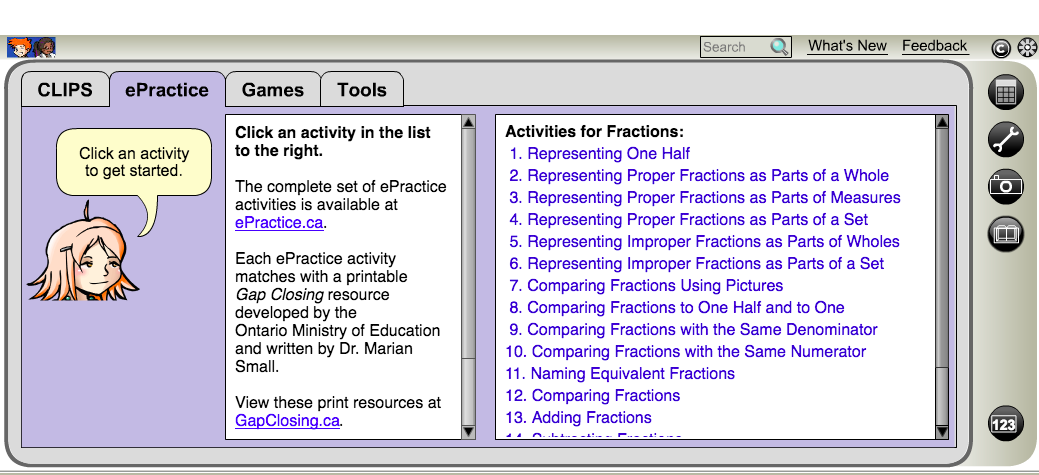
Math Clips and ePractice
Mathclips.ca is a great resource that I found for different math strands and topics from grades 7 - 12. The website provides various resources such as clips, activities, educational games, and tools. Both teachers and students can use this website for additional support or for various ideas.
ESPN
ESPN
is a great website that deals with numbers of all the sports around the world.
What we can do as teachers is that we can have the students log onto this
website and choose a sport that they are most interested in. When they do so,
we can assign different questions that they need to answer depending on the
sport they have chosen. For example, if a student picks basketball, they would
have to go through all 15 games that were played. Questions that we can ask
are: make a bar graph representing the scores of each team. Use intervals.
The
reason why I chose this website is because each student can choose a sport they
mostly like. By doing so, they are interested in what they will be doing no
matter whether they understand the lesson or not. If they didn’t understand the
lesson, by having them interested in what they are doing will definitely help
with having them understand it.
Tuesday, November 7, 2017
Who Invented 'Zero'?
Yet another link that comes from the NY Times website! This was a great read though, diving into who is responsible for the development of the concept of "zero". There is always such a weight placed on cross-curricular lessons, especially with literacy and math/science. It's nice to try and find articles that connect different subjects. With this example, we have Math, Literacy, and History and its tied to something we use every day. It is about a month old, but worth the read if you're sippin' coffee and doing some KenKen (ha.).Cheers gang
Sunday, November 5, 2017
Yummy Math
Yummy Math is a great
resource that I have found to have math activities that are related to current events.
This website provides students and teachers with engaging real life math activities.
This past week was Halloween, and there are so many different activities that
we can use in our lessons.
So the activity I was
looking at was about Holiday Candy Sales. We can start our lesson by asking the
students:
- Which
holidays are associated with candy?
- For
which of those holidays is the most candy sold?
- What
percents of annual candy sales does each holiday contribute?
We this activity, we
can have students
work on independent think time, then small group discussion, then whole group
discussion as kids reason and estimate with these questions. We can have the
students translate a pie chart of information on candy sales to actual dollars
spent for Halloween, Easter, Christmas/Hanukka, and Valentine's Day.
We can
hand out some candy in the class to the students and ask them to look into the
amount of money that is being spent every year on candy during this holiday.
Thursday, November 2, 2017
Growth Mindset and Math
I came across this video, I really liked it because it explains how all students can learn math at any level they want to.
I'm not sure if anyone is familiar with Growth Mindset theory, I've posted a chart below but basically it tells us that everyone has a mindset about their own learning beliefs and potential. People with a growth mindset believe anyone can learn and grow their mind through practice and hardwork. Those who do not share this mindset, having a fixed mindset, believe people are either smart or not and you cannot change who you are.
A little cheesy at times, but it is a great motivational video. It focuses on these main points:
- Making mistakes is okay, even helps you learn
- Speed is not important, take you time
- Most importantly, math is not about memorization, it is visual and creative
Task: Become a math rock star
Throughout
our course we have been discussing ways of making math learning real for
students, creating our own questions as well as the relative merits of different
textbooks. Here’s an interesting teacher whose life story intertwined
all these elements and more.
James Stewart was a math professor at McMaster
whose students were so impressed by his lecture notes that they convinced him to
write his own textbook. It turns out that the students were on to something and
the lucidity of his calculus textbooks garnered him millions of dollars in
royalties. What would an eminent professor do with his earnings? Design a house
that pays homage to his passion, of course. The result is the House that Math
Built, an architectural marvel clinging to the edge of a Toronto ravine.

Students
may have already heard of mathletes, but I can think of classes that would also
be interested in the idea of a math “rock star”. A quick virtual tour of this
building could lead to conversations about the different math-related careers mentioned elsewhere on this blog (not to mention their potential remuneration). James Stewart has some interesting views on
how textbooks should be crafted here. Who knows, maybe one of us will create
our own math Xanadu one day.
Read more about James Stewart's life and career here.
Subscribe to:
Posts (Atom)